the yellow wallpaper
The Yellow Wall PaperThe yellow wallpaper is the room’s most intrusive object and the central image through which the narrator’s attention and sense of confinement take shape. Its disordered pattern and sickly color first provoke disgust; as she studies it in changing light, she sees a woman trapped behind its design, then joins that imagined woman in pulling the paper down. The wallpaper thus develops from an ugly furnishing into the surface on which the narrator’s perceptions of imprisonment and escape converge.
Appearance and Setting
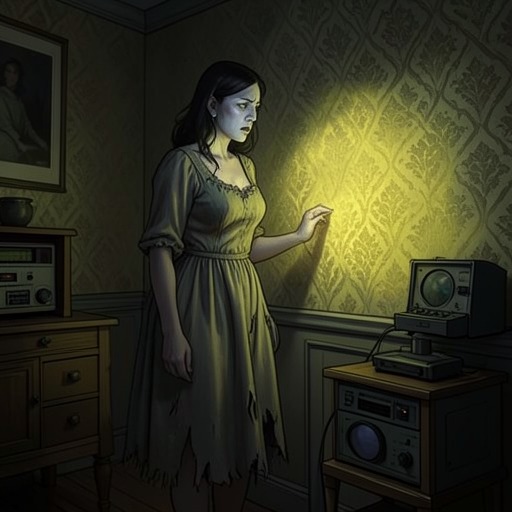
The wallpaper covers the walls of the upstairs nursery, a large, airy room occupying nearly the whole top floor. Its condition is already marked by damage: broad patches have been stripped away around the head of the bed, as far as the narrator can reach, and another large area has been torn off low down on the opposite side. The room’s barred windows and rings fixed into the walls belong to its history as a nursery, playroom, and gymnasium; against that setting, the damaged paper suggests both a space made for children and a place where movement is constrained.
The design is sprawling and flamboyant, but its intricacy offers no satisfying order. The narrator finds it difficult to follow, yet so pronounced that it continually irritates her into looking again. Its uncertain curves abruptly plunge at outrageous angles and seem to contradict or destroy themselves. The wallpaper therefore does not merely offend her taste: its visual structure repeatedly invites interpretation and frustrates any attempt to arrive at a coherent pattern.
Its color compounds that effect. The narrator describes a smouldering, unclean yellow, faded by slowly turning sunlight; elsewhere it shifts toward dull, lurid orange or a sickly sulphur tint. Rather than settling into a stable appearance, it varies across the room and with the light. Its repellent color and unstable design make it an object of sustained attention, even as the narrator recognizes how unpleasant it is.
Watching and Changing Perceptions
The narrator’s response grows from irritation into preoccupation. She comes to feel that the paper occupies her mind, and spends hours lying on the great immovable bed, which she believes is nailed down, tracing the pattern from a corner and trying, for the thousandth time, to follow it to a conclusion. She knows enough about design to judge that it follows no principle of radiation, alternation, repetition, or symmetry. Her scrutiny offers a kind of exercise, but its repeated failure to discover order also keeps her fixed on the wallpaper.
At first the most disturbing details seem to belong to the front design: a recurrent spot resembles a broken neck, and bulbous eyes stare upside down. The eyes appear along the room and in a line where two strips of paper fail to match, one seeming slightly higher than the other. The narrator becomes angry at their impertinence and persistence. These forms make looking feel reciprocal: the paper seems not only to be inspected but to stare back.
In certain light, especially where the paper has not faded, the narrator begins to discern a second, formless figure skulking behind its conspicuous front pattern. She says that this dim shape becomes clearer with each day and that, though it appears in many instances, it is always the same shape. She eventually identifies it as a woman stooping and creeping behind the design. The discovery changes the wallpaper from an incomprehensible pattern into an apparent barrier concealing a living presence.
Light determines how clearly the concealed woman can be seen. By daylight she appears subdued and quiet, as if the pattern holds her still. At night, in twilight, candlelight, lamplight, and most plainly by moonlight, the outer design becomes bars, and the woman behind it stands out. The paper seems to transform without changing its material form: what looks like a pattern by day becomes a prison-like grille after dark. That contrast makes the narrator’s watching inseparable from the alternation of light and shadow.
The Woman Behind the Pattern
The narrator’s interpretation becomes increasingly active and dramatic. She decides that the front pattern moves because the woman behind it shakes it. Sometimes she imagines many women behind the design, sometimes only one; the crawling figure’s movement appears to make the whole pattern tremble. In bright areas, the woman stays still, while in the shade she grips the bars and shakes them. The wallpaper’s visual instability is thus recast as the trace of an effort to escape.
The figure is not simply hidden: she is repeatedly trying to climb through. The narrator believes the pattern strangles anyone who attempts the passage, which accounts, in her account, for its many heads. Women who get through are turned upside down and left with white eyes. These perceptions connect the paper’s earlier broken curves, staring eyes, and irregular design to a vivid image of capture and frustrated escape. The wallpaper’s pattern becomes both the barrier and the apparent instrument of harm.
The narrator also imagines that the woman creeps outside the wallpaper. She sees her creeping along the garden walk and in the long road beneath the trees, and describes her as always crawling, with most women not crawling in daylight. This apparent movement beyond the wall broadens the wallpaper’s significance: the figure’s confinement is no longer limited to what can be seen on its surface, while the narrator’s sense of the woman’s presence extends into the surrounding grounds.
Destruction and Significance
The narrator’s relation to the wallpaper turns from watching to intervention. One night, after Jennie asks to sleep with her, the narrator arranges to be alone. When moonlight brings the woman’s apparent struggle back into view, she gets up to help. She and the figure seem to pull together: the narrator pulls while the woman shakes, and then they reverse their efforts. Before morning, they have peeled off yards of paper, including a strip about as high as the narrator’s head that extends halfway around the room. By daylight, when the pattern seems to laugh at her, she resolves to finish the work that day.
At the end, the narrator says that she has escaped despite John and Jane, and points to the paper she has pulled off as proof that she cannot be put back. The declaration fuses the narrator’s own action with the escape she has attributed to the woman behind the pattern. As she keeps creeping around the room, John faints across her path; she has to creep over him each time. The wallpaper’s removal does not produce a conventional, settled release. Instead, its destruction accompanies the narrator’s final identification with the figure she believed was trapped inside it.
The wallpaper’s changing surface gives material form to the story’s conjunction of confinement and resistance. Its bars, eyes, strangling pattern, and concealed woman gather the narrator’s perceptions into a single image that becomes more legible to her as she watches it repeatedly. The final tearing makes that image physical: she does not merely interpret the barrier but strips much of it from the walls. Yet the ending preserves the tension between liberation and collapse, since the narrator’s claim to have escaped arrives together with her continued creeping and John’s fainting. The wallpaper matters not only as a symbol of imprisonment, but as the object around which the narrator’s increasingly consuming effort to see, help, and get out takes form.